The narrative surrounding cryptocurrency mining has evolved dramatically. What began in 2009 as an experimental hobbyist pursuit—conducted on standard multi-core desktop CPUs in home offices—has morphed into a capital-intensive, multi-billion-dollar global infrastructure industry.
Today, mining facilities occupy gigawatt-scale campuses, operate specialized hydro-cooled silicon, integrate directly into national energy grids, and even dual-purpose their high-voltage electrical substations for Artificial Intelligence (AI) and High-Performance Computing (HPC) workloads.
Yet, for individual investors and prospective enterprise operators alike, the central question remains: How does cryptocurrency mining actually work in the modern era, and is it still profitable?
This guide breaks down the underlying cryptography, operational infrastructure, economic formulas, realistic profitability metrics, and strategic risks defining cryptocurrency mining today.
1. The Core Architecture: How Proof-of-Work (PoW) Operates
To evaluate mining profitability, one must first strip away the financial market hype and understand the thermodynamic and mathematical mechanisms securing Proof-of-Work blockchains.
The Cryptographic Hash Race (SHA-256)
At its core, mining is not about solving complex calculus or deciphering arbitrary riddles; it is a probabilistic guessing game governed by cryptographic hash functions (such as Bitcoin’s SHA-256 or Kaspa’s kHeavyHash).
Transaction Pooling: When users submit transactions, they enter a waiting room called the mempool.
Block Construction: A miner’s node aggregates thousands of these pending transactions, packages them into a block template, and summarizes them into a single 32-byte cryptographic root known as the Merkle Root.
The Nonce Search: The miner combines the block header (version, previous block hash, timestamp, Merkle root, and target difficulty) with a variable number called a nonce (number used once).
Hashing Execution: The hardware runs the combined data through the hashing algorithm. The resulting output is a 64-character hexadecimal string
The Winning Condition: The calculated hash must be numerically lower than or equal to a specific target threshold set by the network. Because hash functions are mathematically non-invertible, the only way to find a qualifying hash is sheer trial and error—iterating billions of nonces per second across global hardware fleets.
The Difficulty Adjustment Algorithm (DAA)
One of Satoshi Nakamoto’s crucial inventions was the self-regulating Difficulty Adjustment. In Bitcoin, every 2,016 blocks (roughly every two weeks), the network evaluates how fast blocks were discovered:
If total computing power (hashrate) increases, blocks are solved in less than the target 10 minutes -> Difficulty increases automatically.
If miners shut down unprofitable rigs and hashrate falls -> Difficulty drops automatically.
This programmatic governor guarantees an issuance rate that remains unyielding regardless of how much capital or hardware is deployed globally.
2. The Mining Hardware Spectrum: ASICs, GPUs, and FPGAs
The hardware landscape has undergone severe specialization. General-purpose hardware has been completely outpaced on major networks.
A. Application-Specific Integrated Circuits (ASICs)
ASICs are silicon chips engineered exclusively to calculate one single mathematical algorithm. Unlike commercial graphics cards, an ASIC cannot render video or run neural networks; it does only one task with extreme efficiency.
Key Metric — Energy Efficiency ($J/\text{TH}$): Hardware is rated in Joules per Terahash (J/TH). Modern flagship units (such as the Bitmain Antminer S21 Pro / S21 XP series or Whatsminer M60 series) achieve efficiencies between 12 to 15 J/TH, rendering older units (like the classic 85–100 J/TH Antminer S9) completely unviable on commercial energy rates.
B. Graphics Processing Units (GPUs)
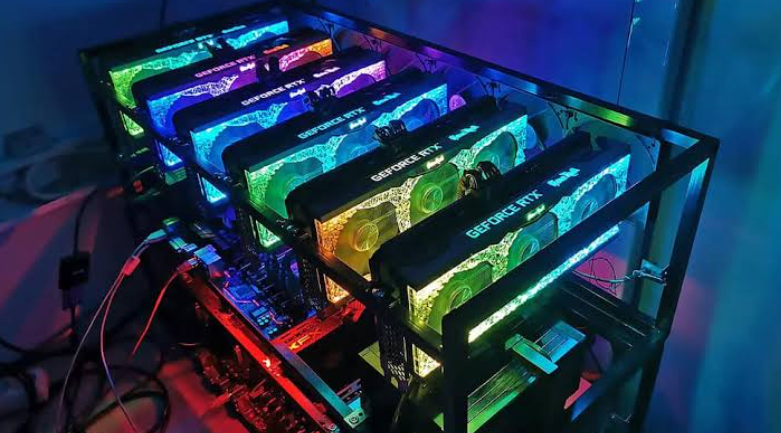
Following Ethereum’s transition from Proof-of-Work to Proof-of-Stake («The Merge»), GPU mining shifted to a fragmented long-tail of altcoins resistant to ASIC development (e.g., Ravencoin [KawPoW], Ergo [Autolykos2], OctaSpace). While flexible, GPU mining margins remain razor-thin, prompting many operators to redirect their graphics clusters toward distributed AI inference and 3D cloud rendering.
C. Hardware Cooling Paradigms: Air vs. Hydro & Immersion
Modern hardware economics depend heavily on cooling architecture:
Air Cooling: Standard fans; lower capital cost, but high acoustic noise (75–85 dB) and vulnerable to dust, thermal throttling, and ambient heat degradation.
Hydro / Direct-to-Chip Cooling: Closed-loop water jackets delivering fluid across the ASIC dies, slashing auxiliary fan power consumption.
Immersion Cooling: Submerging entire ASIC hashboards in non-conductive dielectric fluid. This permits over-clocking of hash output by 20–40%, eliminates thermal hotspots, and extends hardware lifespan, albeit at a higher upfront infrastructure cost.
3. The Modern Unit Economics of Crypto Mining
To establish whether crypto mining is profitable today, one must analyze the mathematical equation governing gross miner revenue:
Daily Net Profit= Hashrate Share x Daily Network Rewards x Asset Price} – Total Operational Costs
The Critical Metric: «Hashprice»
Institutional analysts measure mining economics using Hashprice—a term popularized by Luxor Technologies. Hashprice represents the expected daily revenue per unit of computing power (e.g., USD per Petahash per day: $/PH/day or satoshis/TH/day).
When network difficulty climbs or the block subsidy halves, hashprice falls unless the asset’s spot market price rises proportionately or transaction fees surge.
The Real Cost of Production
The total cash cost to mine one Bitcoin is primarily a function of fleet efficiency and power tariff:
Power Cost (/kWh)
Modern Fleet (15 J/TH)
Mid-Tier Fleet (22 J/TH)
Legacy Fleet (35 J/TH)
$0.03 / kWh
~$28,000 – $34,000 / BTC
~$42,000 – $48,000 / BTC
~$68,000 – $75,000 / BTC
$0.05 / kWh
~$47,000 – $55,000 / BTC
~$70,000 – $80,000 / BTC
~$112,000 – $125,000 / BTC
$0.08 / kWh
~$75,000 – $88,000 / BTC
~$110,000 – $128,000 / BTC
Unprofitable
$0.12 / kWh (Residential)
Unprofitable
Unprofitable
Unprofitable
(Figures reflect post-4th halving base block reward of 3.125 BTC, assuming standard baseline transaction fee levels).
4. Is Crypto Mining Still Profitable? The Reality Check
The short answer is yes, but strictly under specific operational, geographic, and financial conditions.
The era of plug-and-play residential mining in a suburban garage is functionally obsolete for major Proof-of-Work networks. Mining is an industrial commodity conversion business: converting cheap raw electrical energy into high-liquidity digital monetary reserves.
Who Wins: Industrial Operators & Energy Co-Locators
Profitable operations share common structural characteristics:
Sub-4-Cent Power Tariffs: Access to long-term power purchase agreements (PPAs) or direct co-location with stranded energy (hydroelectric spills, flared natural gas, off-grid solar/wind curtailment) under $0.025 to $0.045 per kWh.
High-Density Capital Investment: Purchasing hardware in volume directly from foundries/manufacturers (Bitmain, MicroBT, Canaan) at wholesale pricing ($/TH discounts).
Grid Ancillary Services (Demand Response): Industrial miners partner with electrical grid operators (e.g., ERCOT in Texas). When heatwaves or winter storms spike municipal power demand, miners instantly power down their machines, earning curtailment credits that drastically lower their net effective annual electricity cost.
Who Loses: Retail and Residential Miners
Home mining faces fundamental disadvantages:
Unfavorable Power Rates: Average consumer residential power rates in North America and Western Europe hover between $0.12 and $0.30 per kWh, creating negative daily operational margins.
Thermal and Acoustic Bottlenecks: Commercial ASICs produce 75+ decibels of continuous high-frequency noise and exhaust heat comparable to multiple space heaters.
Hardware Depreciation Drag: In a bear or sideways market, hardware purchased at premium retail markup can lose 50–80% of its market value before reaching operational break-even (ROI).
5. Solo Mining vs. Pool Mining vs. Cloud Mining
Prospective miners must select an execution structure. Understanding the mechanics of each pathway is critical:
1. Mining Pools (The Standard Approach)
Because finding an individual block on a 600+ Exahash network is statistically improbable for smaller operators, miners combine their computing power into a Mining Pool (e.g., Foundry USA, AntPool, F2Pool, ViaBTC).
Reward Systems:
FPPS (Full Pay-Per-Share): The pool guarantees payout for every valid cryptographic share submitted, covering both block subsidy and estimated transaction fees. Low variance, standard pool fee (1.5%–2.5%).
PPLNS (Pay-Per-Last-N-Shares): Rewards are calculated only when the pool successfully finds a block on-chain. Slightly lower fees (0.5%–1.0%), but introduces short-term variance.
2. Solo Mining (The Cryptographic Lottery)
Solo mining means aiming your hashrate directly at your own node without a pool intermediary. If you find a block, you keep the entire 3.125 BTC reward plus all associated transaction fees.
The Catch: With an individual 200 TH/s machine against an 800 EH/s network, your statistical probability of discovering a block can be 1 in several decades. Specialized small hardware units (like the Bitaxe open-source micro-miners) are deployed by hobbyists as educational «lottery tickets» rather than systematic investments.
3. Hosted Facilities (Colocation)
Rather than running machines at home, retail investors purchase ASICs and contract with an institutional data center that provides rack space, cooling, maintenance, and wholesale power ($0.065–$0.085/kWh all-in). While viable, investors must carefully scrutinize hosting contracts for uptime guarantees, curtailment revenue-sharing, and exit fees.
4. Cloud Mining (Major Warning)
Cloud mining involves renting hashrate through a third-party website with no physical hardware delivered.
The Reality: A vast majority of cloud mining offerings function as opaque schemes or carry hidden management fees that make them mathematically inferior to simply purchasing and holding the underlying cryptocurrency spot asset (HODLing).
6. Strategic Shifts: The AI Pivot and Stranded Energy
The modern mining sector is evolving through structural intersections with energy infrastructure and artificial intelligence.
The AI & High-Performance Computing (HPC) Pivot
Major publicly traded mining conglomerates (such as Core Scientific, IREN, Bit Digital, and Hut 8) have transitioned portions of their high-voltage power capacity toward AI infrastructure and cloud GPU clusters.
Why? Enterprise AI cloud compute leases provide multi-year, predictable recurring revenue with high credit ratings, balancing out the volatility of Bitcoin hashprice cycles.
The Distinction: Bitcoin mining acts as an interruptible, non-latency-sensitive load that can operate anywhere power exists. AI data centers, by contrast, require low-latency fiber backbones and redundant power grids. This symbiotic balance allows operators to monetize cheap, off-grid energy via mining while provisioning tier-3 infrastructure for AI compute.
Stranded and Methane-Mitigating Energy Systems
Mining is increasingly deployed as an environmental remediation tool:
Methane Abatement (Flared Gas): Oil and gas producers channel excess methane gas—traditionally burned directly into the atmosphere—into mobile generator trailers running on-site ASIC containers.
Renewable Stabilization: Solar and wind farms deploy collocated mining rigs to monetize surplus peak generation that local grid transmission lines cannot physically absorb.
7. Comparative Framework: Mining vs. Direct Spot Investment
For individual investors evaluating entry into the Proof-of-Work ecosystem, comparing physical mining operations against buying the asset directly clarifies capital allocation:
Dimension
Industrial Mining Operator
Retail / Home Miner
Direct Spot Buying (DCA / ETF)
Upfront Capital (Capex)
High ($100k – Millions)
Moderate ($1,500 – $6,000)
Zero (Buy any fraction)
Operational Overhead (Opex)
Power agreements, staff, cooling, monitoring
High electricity bills, noise, thermal exhaust
None (or minor ETF fee)
Regulatory / Tax Complexity
Corporate tax, depreciation schedules, energy compliance
Complex self-employment & asset income tax
Simplified capital gains tax
Market Volatility Exposure
High operating leverage; risk of negative cash margins
Severe downside risk during market drops
Standard price volatility
KYC / Privacy Footprint
Fully audited corporate compliance
KYC on exchange purchases; non-KYC on solo rigs
Standard KYC on regulated brokers
Primary Advantage
Generates BTC below market price at scale
Hands-on hardware education
Frictionless liquidity, zero operational risk
8. Summary Checklist: Evaluating a Mining Venture
Before deploying capital into mining hardware today, evaluate these practical criteria:
[ ] Power Tariff: Is your all-in, delivered electricity cost verifiably under $0.045 / kWh?
[ ] Fleet Efficiency: Is your hardware operating at sub-20 J/TH performance?
[ ] Network Difficulty Modeling: Have you stress-tested your cash-flow models against steady difficulty growth?
[ ] Thermodynamic Management: Do you have proper airflow ventilation or immersion cooling to prevent thermal throttling?
[ ] Downtime Contingency: Can your balance sheet handle extended periods where hashprice falls below your operational breakeven?
If these conditions cannot be met, acquiring the asset directly via dollar-cost averaging (DCA) or spot investment vehicles generally provides a superior risk-adjusted return without operational exposure. For those with access to ultra-low-cost, stranded power, cryptocurrency mining remains one of the world’s most resilient compute-driven commodity businesses.
Disclaimer: This analysis is for educational and informational purposes only and does not constitute financial, investment, legal, or tax advice. Cryptocurrency mining involves significant capital expenditure, technical complexity, and exposure to volatile market dynamics.